Choosing a diamond is rarely just about numbers. It’s about certainty – the quiet confidence that what you’re choosing will hold its beauty, its meaning, and its integrity over time. An IGI diamond certificate exists to support that confidence, offering an independent and transparent assessment of a lab grown diamond’s quality. Rather than something to decode line by line, an IGI report is best understood as a guide – pointing you toward the details that truly shape how a diamond looks, feels, and performs once worn.
What an Igi Certificate Tells You
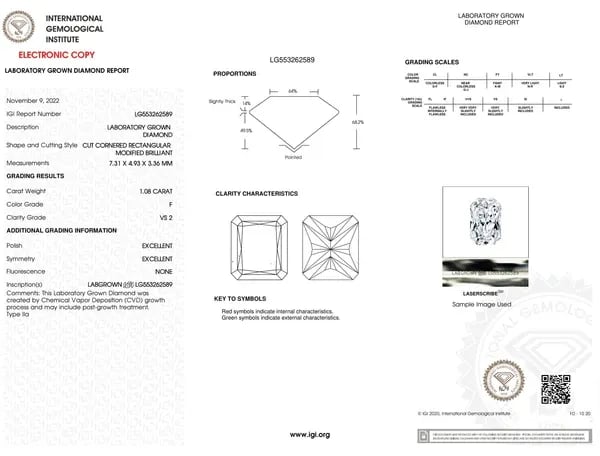
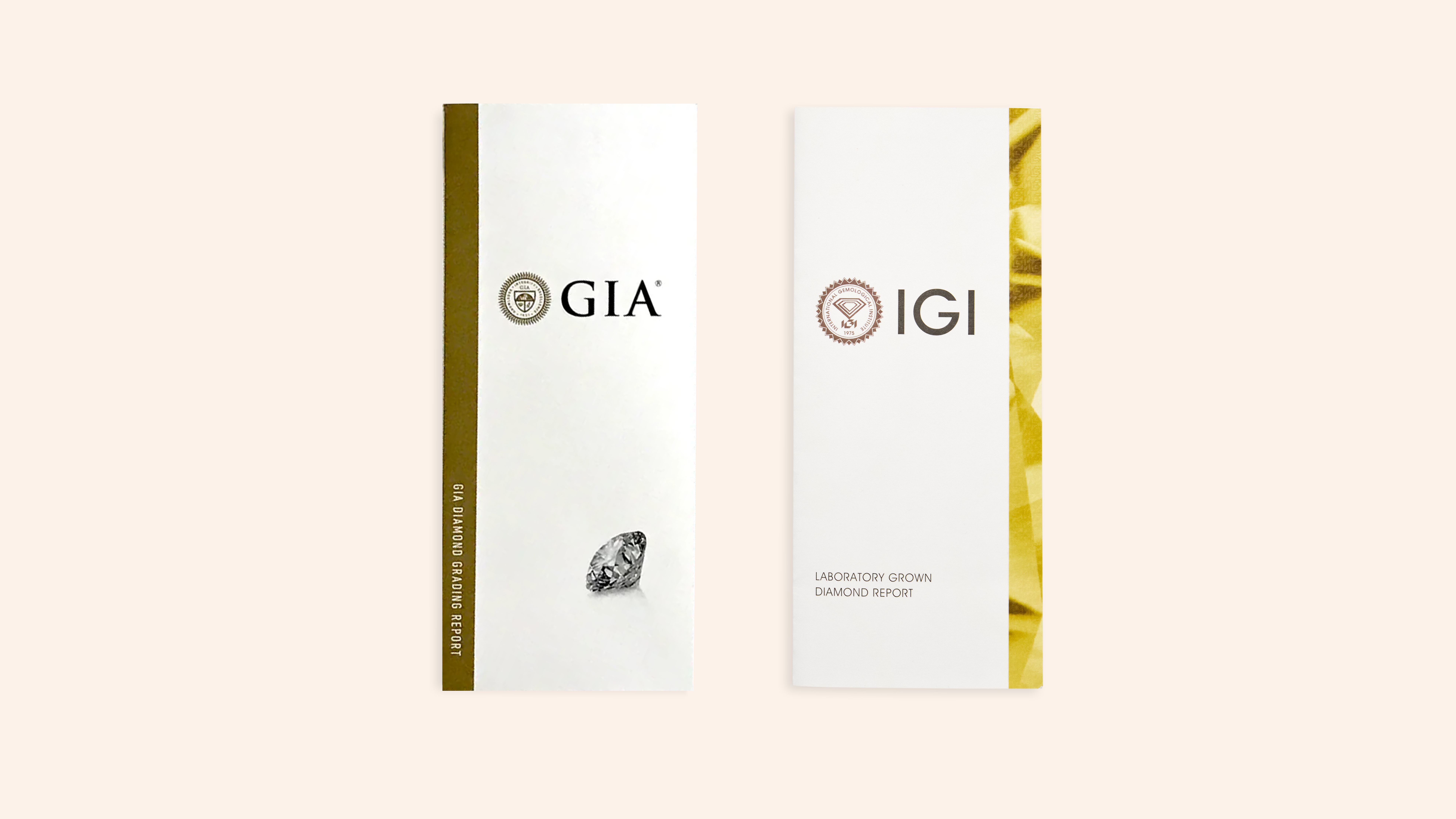
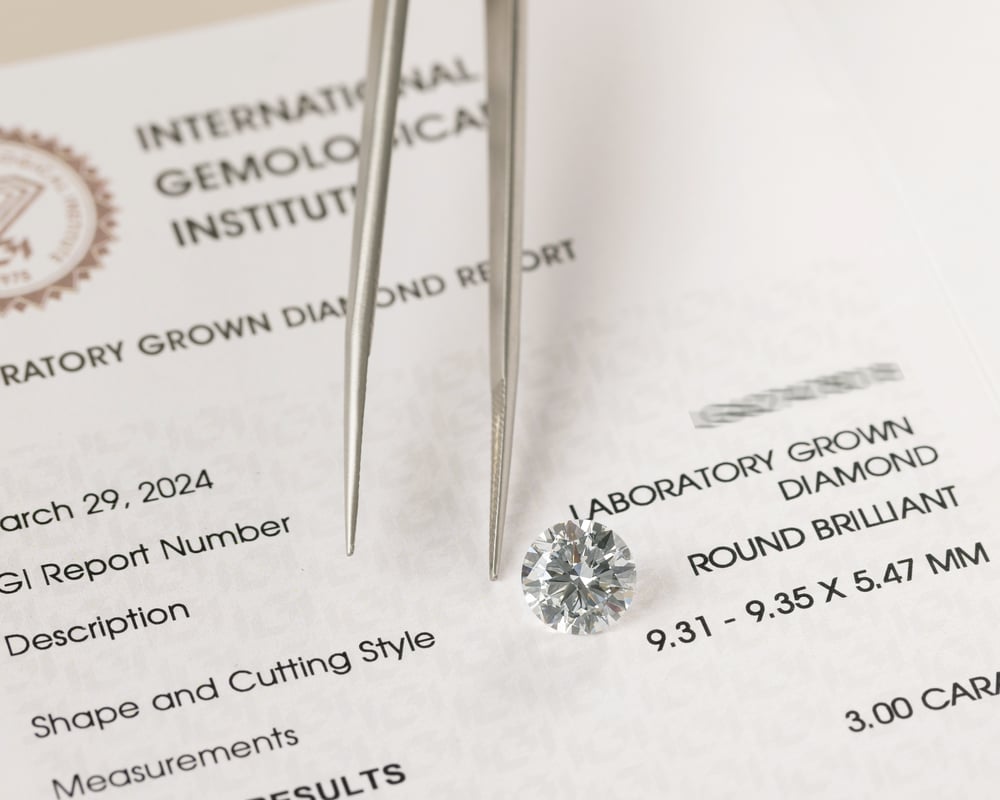
An IGI (International Gemological Institute) certificate is a detailed record of a lab grown diamond’s key attributes, including its size, shape, colour, clarity, cut (for round diamonds), proportions, and finish. It also confirms the diamond’s laboratory-grown origin and includes a unique report number that links the document to the stone itself. Alongside GIA, IGI is one of the most widely recognised gemological laboratories in the world. Its grading reports are trusted by jewellers and consumers globally, offering a consistent framework for assessing diamond quality.
The Key Sections to Understand
Identification and measurements
At the top of the report, you’ll find the diamond’s shape, cutting style, and physical measurements. These measurements reveal more than carat weight alone – they influence how large the diamond appears when viewed from above.
The 4 Cs
The grading results section outlines carat weight, colour, clarity, and cut. While all four matter, cut has the greatest influence on how a diamond interacts with light. For round diamonds, cut is formally graded by IGI and reflects brightness, fire, and overall balance.
Colour is graded on a scale from colourless to light yellow, while clarity reflects the presence of natural inclusions, assessed under magnification. These characteristics help describe a diamond’s appearance rather than its durability or quality of craftsmanship.
Finish and symmetry
Polish and symmetry indicate how precisely the diamond has been finished. Well-balanced facets and a smooth surface allow light to reflect evenly, contributing to a brighter, more harmonious appearance.
Proportions
The proportions diagram shows how the diamond has been cut – including table size, depth, crown, pavilion, and girdle. These measurements are essential to understanding light performance. Well-balanced proportions support brilliance and visual presence, while poorly balanced ones can result in light loss or a smaller face-up appearance.
Clarity characteristics
A plotted diagram maps the location of inclusions within the diamond. These marks can look confronting at first, but most inclusions are microscopic and have little impact on beauty when well placed.
Comments
This section may include any additional information or observations about the diamond relevant to its quality or authenticity. THis includes information about the diamond's origin (CVD vs HPHT), any treatments or enhancements it has undergone, or any other unique characteristics it possesses. The Comments section may also mention if the diamond has been laser drilled (a treatment used to remove inclusions) or if it has been coated with a thin layer of another material to improve its appearance. It may also include any observations about the diamond's fluorescence (a glowing effect under UV light) or its symmetry (the alignment of its facets).
Grading Results
The Grading Results section includes the diamond's carat weight, as well as its colour, clarity, and cut grades (only applicable to round diamonds for now), which are used to describe the diamond's appearance.
Colour grade: This describes the degree of colour present in the diamond, with grades ranging from D (colourless) to Z (light yellow). The colour of a diamond is determined by comparing it to a set of master stones under controlled lighting conditions. The diamond is assigned a colour grade based on how closely its colour matches that of the master stones.
Clarity grade: This describes the size and number of inclusions present in the diamond, with grades ranging from FL (flawless) to I3 (included). Diamond clarity is determined by examining it under a microscope and assessing the visibility and location of any inclusions.
Cut grade: This outlines the quality of a round diamond's cut, which refers to how the diamond's facets (the flat faces on the diamond's surface) are shaped and angled. A diamond's cut is evaluated based on factors such as its brightness (the amount of light reflected), its fire (the dispersion of light into the colours of the rainbow), and its symmetry (the alignment of its facets). The cut grade of a diamond ranges from Excellent to Poor.
Why the Certificate Matters
An IGI certificate offers more than technical detail – it offers assurance. It verifies that a diamond has been independently assessed, confirms its laboratory-grown origin, and provides a reliable reference for insurance and long-term care. At Cullen, we view certification as part of our considered approach to jewellery – one that values transparency, informed choice, and enduring design. Understanding how to read an IGI certificate allows you to look beyond surface metrics and focus on what truly matters: how a diamond performs, how it feels, and how confidently it can be worn every day.